
Kaala chana
Bends & Flows
The bend of a road and the flow of a river — a visual and aural experience for toddlers, made from a material every one of us already knows.
- 18 months – 3 years
- 28 minutes
- 2 performers
- Non-verbal
- First performed 2012
Premiered 26 July 2012 at Ranga Shankara, Bengaluru, as part of the AHA! International Theatre Festival for Children.
The play
Everything is always in transformation.
The possibility of change is already built into that which exists.
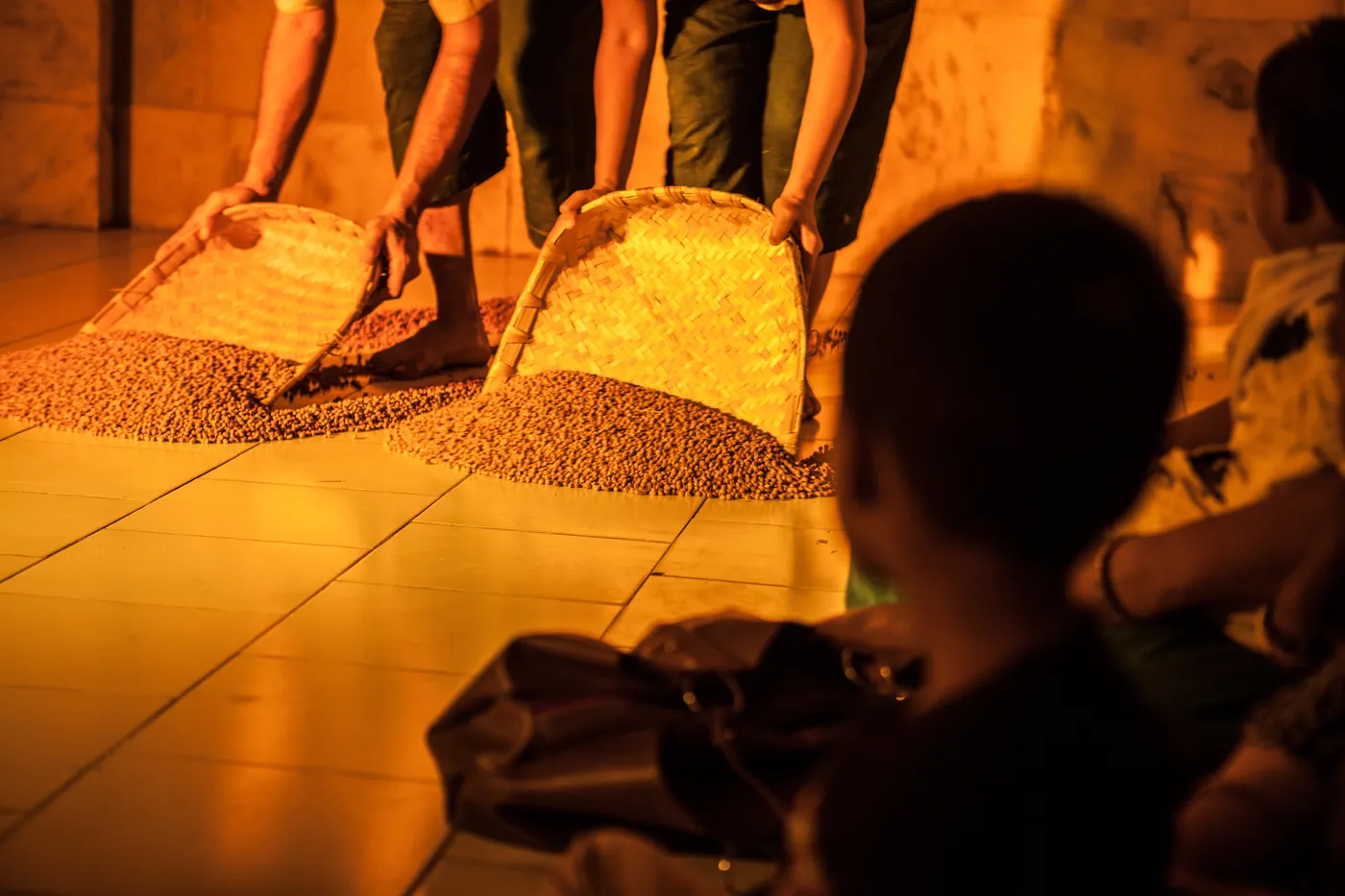
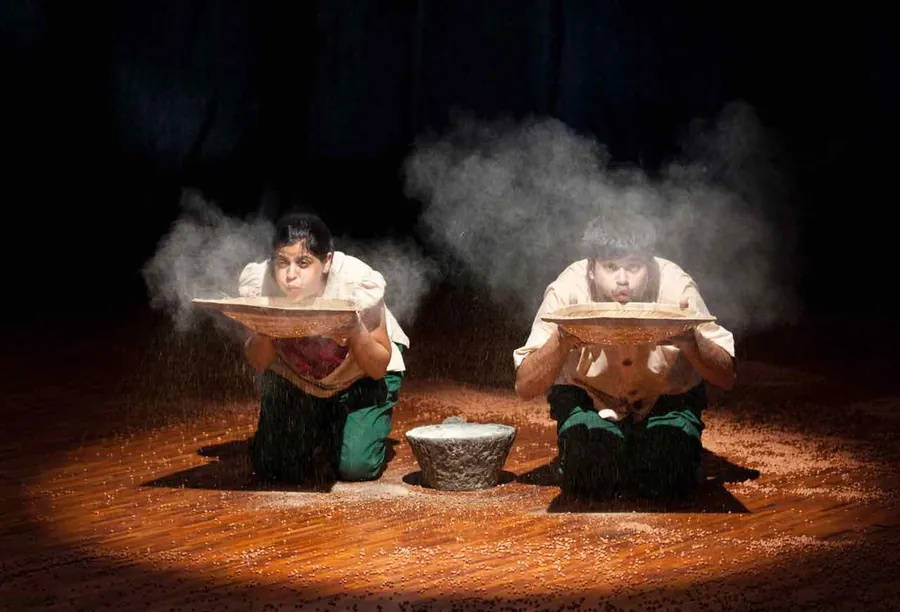
Bends & Flows works through the metaphors of the bend of a road and the flow of a river. It uses a single tangible material — kaala chana, black gram — to create a visual and aural experience for a very young audience, while allowing glimpses of the hidden narratives that accompany those rhythms and images. It is not a linear narrative with a beginning and an end.
Work on the play began with the material because the material was irresistible. We could never really hold ourselves back when confronted with a room full of chana. We found ourselves playing with it at all times, even when we were supposed to be clearing it away and putting it back in the bag. We decided to go with that instinct — engaging an audience as young as eighteen months could never be about anything else.
We hope they take back images, sounds and emotions, and construe it all into an experience as they would like it to be.
Background
The first of its kind in India.
Theatre for toddlers — theatre created by adults for children between eighteen months and three years — was, when we began, a new idea in this country. It took shape for us through a workshop run by Ranga Shankara with the Max Mueller Bhavan in Bengaluru, which brought in a theatre pedagogue from Germany specialising in making work for the very young.
That workshop sowed the seed. Bends & Flows premiered on 26 July 2012 at Ranga Shankara, as part of the AHA! International Theatre Festival for Children — the first full-fledged theatre production for toddlers to be staged in India.
Made in collaboration with Ranga Shankara, the National School of Drama and the Max Mueller Bhavan.
For presenters
Technical
This is made for an audience that has not experienced theatre before, and does not behave like a general theatre audience. The staging conditions below are not preferences — they are what makes the play work.
| Age range | 18 months to 3 years. We ask that only children up to 3 attend. |
|---|---|
| Running time | 28 minutes, no interval |
| Language | Non-verbal |
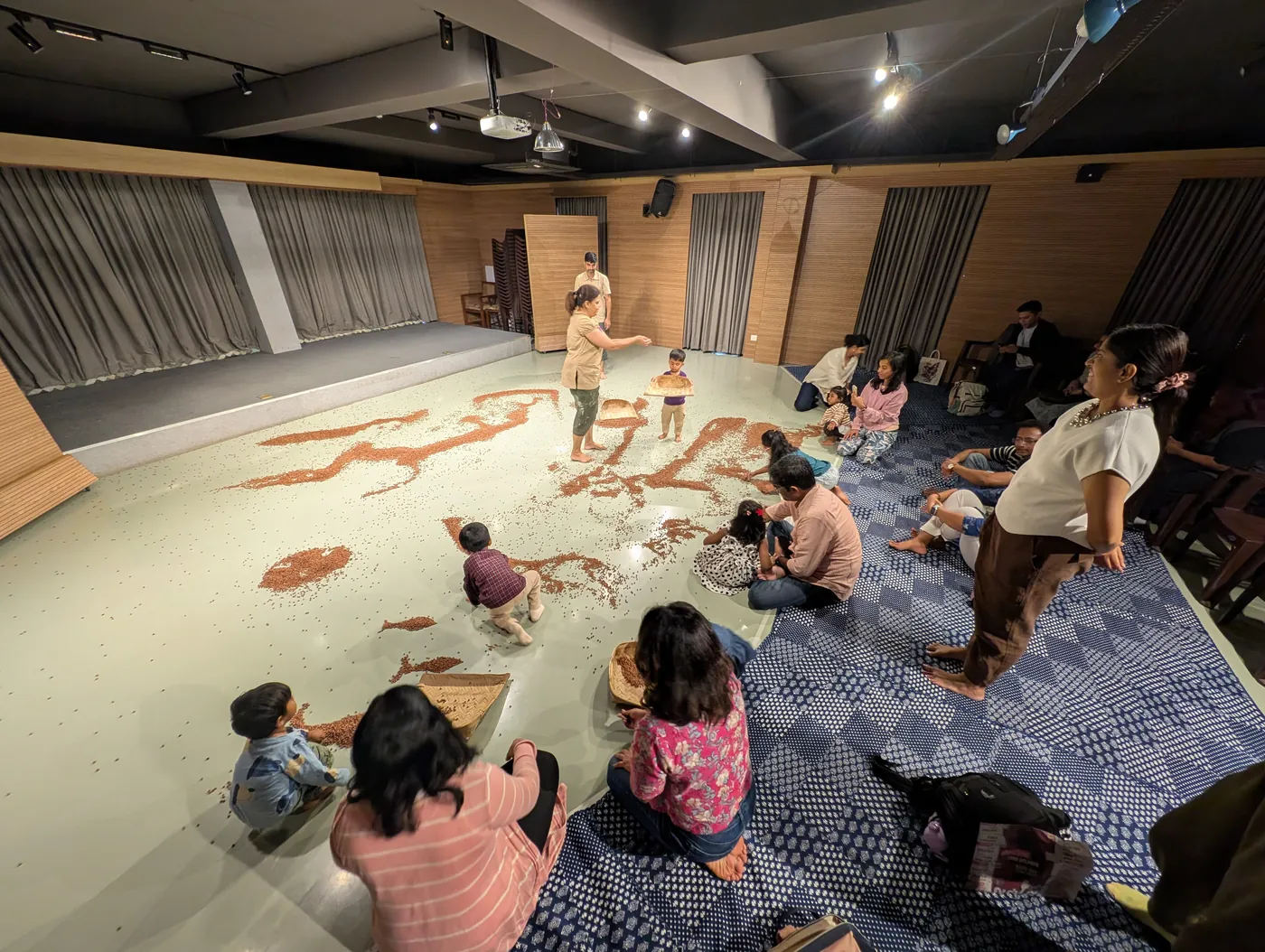
| Audience capacity | 20–25 children, each with one parent or guardian, seated close to the performance area |
| After the play | The children are invited into the performance area to handle the material. We treat this as their feedback on the play, and ask for it to be scheduled in. |
| Cast | 2 performers |
| Company on the road | 2 performers, 1 director, 1 production manager, 1 technician |
| Lighting | The desirable scenario — the play itself is flexible, and has run with far less: 14 PC, 4 profiles, 6 fresnels; rigged FOH, top fly bars, stage-side ladders or at least 6 individual stands, plus floor light. 24 kW dimmer board; console with programming options. |
| Gels | 10 × LEE 105, 4 × LEE 200 |
| Get-in | 2 hrs pre-set and warm-up · 3 hrs rig, focus and programme · 1 hr tech run · 1 hr clean-up |
| Get-out | 1 hour |
| Performance space | [[minimum width × depth × height]] |
In performance
Photographs and clips
Click any frame to open it. Moving tiles play with sound when opened.
Credits
In collaboration with Ranga Shankara, the National School of Drama and the Max Mueller Bhavan.
| Direction | Subhashim Goswami |
|---|---|
| Cast | Samta Shikhar, Shrunga B.V. |
| Premiered | 26 July 2012, Ranga Shankara, Bengaluru — AHA! International Theatre Festival for Children |
| Excerpt | [[the YouTube link in your deck still works — embed it here?]] |